Sunday, 28 November 2010

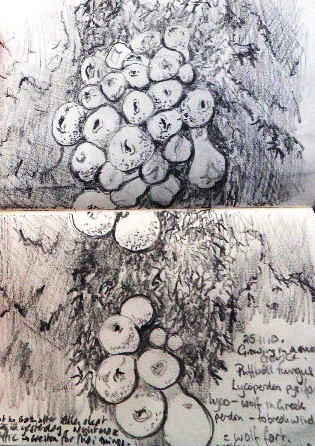
Wolf-farts


Sketched just before the frosts and snow, these little fungi looked beautiful, cascading down the mossy crevice in a tree.  When rain drops on the outer parts, it sends little puffs of the spores inside, like brown dust, so fine it floats away as smoke on the breeze.

The Greek name for these is Lycoperdon Pyriforme; Lyco = wolf; Perdon = to break wind; Pyroforme = pear shaped.

I am not sure where the 'wolf' bit comes in, but the rest is elementary!

P.S.  Don't breathe in the spores.  They are, in quantity, dangerous and will affect your lungs.  If however you find you have inadvertently inhaled the odd puff, no matter.

Thursday, 25 November 2010

Summer beech


For some reason, I don't get round to drawing the summer trees so much.  Realising this, I fished out my little note pad in August and drew this beech which grows is the valley of the wood, next to where the two brooks meet.  The leaves still have their green colouring, but the odd one is tinged with a light coppering.

Sunday, 14 March 2010

Salix Caprea - Goat Willow


Called Goat Willow as the little cloven-hoofed beasts like to eat the fresh green leaves of this tree - when there is still little greenery around, we have small clumps of this tree around the lake and dotted sporadically in the wood.

Those little fluffy heads are more sturdy than they at first seem, the glittering night time frosts still very much present.  I know their leaves won't be far behind and we can all relax as spring ends this protracted winter.

Monday, 25 January 2010

Norway Spruce


There are quite a few of these trees in the wood. There is one thing I am unsure of though. Their lower branches are all knocked off, the foliage being left high up on the bole. Has this been done on purpose to encourage rapid top growth, and therefore nice long planks, or is it animals?  An educated guess would be it is more likely that the canopy is heavy and lets little light through, starving the branches and making them weak and redundant.


The long cylindrical cones of this tree lie about at all times of year, sometimes nibbled like corn on the cob by the squirrel massive.  I do not exaggerate - we are over-run and they are FAT!


Thursday, 7 January 2010

It's snow accident....


... that this one is not actually in my little A6 sketchpad.  It is more of a tree-scene, and therefore worthy of inclusion (I hope)!  Also blogged on Doodles.

Friday, 1 January 2010

January 1st 2010 - janus tree


I am not sure what the name of this tree is - only that it is semi-ornamental and there was a long-eared bat living in it a few years ago.  It seemed an apt choice for the 1st of January as it has two sides.  It reminded me of the Roman god, Janus, looking back with one face on the old year, and another face looking forward to the new.

Half covered in moss with the other side mainly free, it has a split personality.  Looking tropical, believe me, it was not.  I sketched this briefly before returning home to finish off with a photograph.

Tuesday, 22 December 2009

Service Oak


It has been freezing here in Somerset for a few days now and there has been enough snow to bring the country to a moan.  The woodland looks beautiful.  This oak is actually on its side, having fallen two years ago.  I have been informed it is called a service oak and worth some money, but don't ask me what the 'service' actually means.  I have posted the picture as if the tree were still standing as it looks kind of nice - artistic licence!  Sorry to anyone who saw my previous naming of this as a table oak - where did that come from?

Tuesday, 8 December 2009

Hazel catkins

This tenacious little tree puts forth it's flowering bodies at this cold, dark time of year.  being pollinated by the wind, I guess itis better to send pollen out when there is little else around, and not needing insects means it is not tied to certain, warmer times.


A fine day opens their bracts like in this sketch, but usually at this time of year, they hold tight, their scales pressed flat to the body.


We have a few hazel copses in the wood, one of which supports a beautiful sea of bluebells in May and the first part of June.  I understand hazels acheive their maximum worth when they are 16 years old.  Needing constant pruning to maintain a thick multi-stemmed habit, these trees are labour intensive if they are not harvested.  We have Claire, a local spar-maker come into the wood.  Spars are hazel sticks used to push in to secure the thatching in straw roofs.  The best way to harvest Hazel is to cut at an angle, low to the base, and then lay any discarded wood into the crown.  This way, the new soft green growth is protected a little from browsers such as deer.


Monday, 7 December 2009

Goat Willow


Growing near the water's edge at the lake, we have sustained a lot of heavy rain recently.  As I walk round the lake I can hear the ground clicking and sagging, the water slowly draining to the river.

I quickly sketched this sitting on a fishing platform on Sunday - just before the afternoon rain settled in for the rest of the day.

Beech - 04.12.09

In my old primary school, there used to be a huge copper beech set into the grass playing fields.  We used to sit on it's splaying roots and sometimes (season permitting) collect the nuts and lay them on the ground to make pictures.

Now I am told Beech trees are called widow-makers due to their prediliction for droping boughs onto unsuspecting people hiding from heavy rainfall.  Indeed, if any tree is affected by strong winds, it is nearly always the beech which seem to split or even uproot quite easily.


Their wood does not burn exceptionally well and I am told is most used for the interior of furniture, such a sofas and the like.

Friday, 4 December 2009

Oak and Ivy


The 2nd December was a golden winter day.  The kind where the sun hangs low in the sky, lighting all at a theatrical angle. 

Now the tree has lost most of its leaves, the structure is more visible.  The base of this oak is decked out in ivy.  Kind of seasonal but I am sure it would rather not have this decoration.  The ivy is scrambling sky-ward, clambering over itself in its effort to reach the light.


The epicormic growth is the little cushions of extra leaves that pop out on oaks when there is enough light hitting the bark.  These result in the cats-paws effect on planked wood.  It makes it more interesting in my view, but the french, for instance, prefer their oak planks featureless and therefore grow the trees closer together and dark.

Little A6 sketch pad


It's the second day of December and I'm in this art and craft supply shop, The Alms House in Trowbridge, meaning to buy just a pen. Yeh, right. Like how often am I that restrained? I can't help it. It's too much of a temptation not to meander round the corner, wander up and down, pick up some tubes of paint, look at the lovely thick sketchpads of rough / smooth / coloured paper, marvel at the books offering advice on how to do things better. I could spend a small fortune.

Instead I buy this - an A6 sketch pad for £ 2.30. Why is it called Arboreta? Is it because it is made out of trees? Who knows. It is only later, walking the dogs in the wood I look at this tree and think "Oh, like the front of the sketchbook". That's it. Maybe not the inspiration of the century (or even decade, year, month...) but there we go. A tree portrait book. Hopefully I will fill the entire pad of 30 sheets. Hopefully they won't all be awful scratchy renditions and actually bear some resemblance to the actual plant itself.